

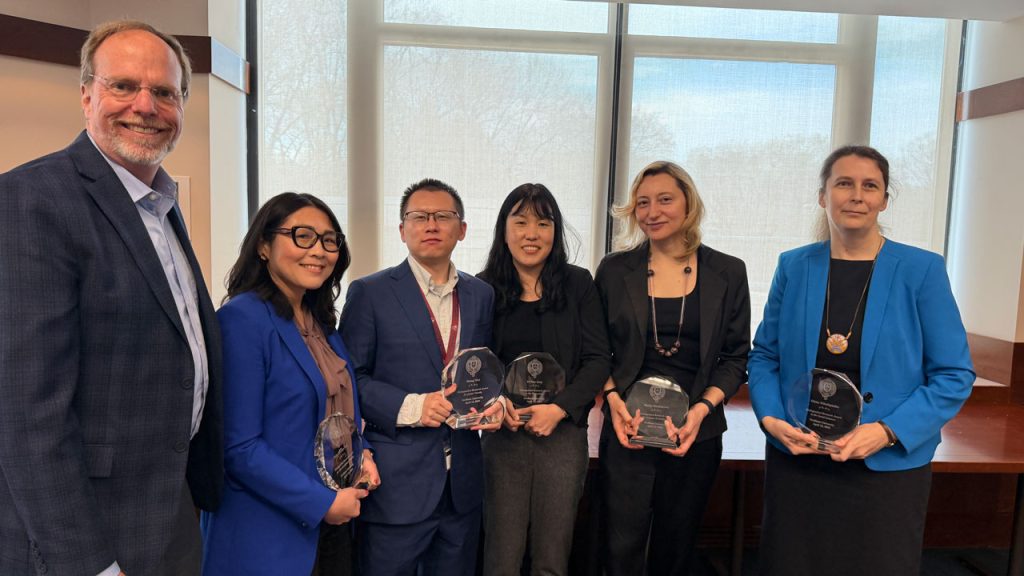
Women’s mental health, constitutional challenges, and the attention economy were among the research topics highlighted at an event recognizing the pioneering scholarship of Fordham’s faculty.
President Tania Tetlow applauded each honoree’s work in her opening remarks at Fordham’s Research Day, held on April 13 at Rose Hill, where faculty members received awards for their scholarship.
Not only does this research help “push forward who we are as a people,” Tetlow said, it inspires Fordham’s students. “You as scholars get to bring all of that to your students in modeling what it means to ask these hard questions,” said Tetlow.
Below are six takeaways from the day.
The study of the Hebrew Bible can connect the ancient past to present crises.
Theology professor Ki-Eun Jang, PhD, recipient of the humanities research award, discussed her methods of interpreting the Hebrew Bible and how she connects this ancient text to recent memories of catastrophe through critical disaster studies. In a curated collection of articles for the Journal of Ecumenical Studies, she juxtaposed the 1923 Kanto Massacre of Koreans in Japan with the biblical narrative of the Gibeonites, yielding a new framework for understanding martial law, sovereignty, and violence across both narratives. Biblical interpretation that considers disparate histories without conflating their particularities, she argued, can “reorient interpretation toward a solidarity of remembrance.”
A ‘shadow court’ could break the Supreme Court’s monopoly on constitutional interpretation.
Fordham Law Professor Julie C. Suk, PhD, recipient of the interdisciplinary studies award, spoke about her decade-long research on the challenges of amending the U.S. Constitution. Her upcoming book, The Shadow Court, grew out of this work and addresses the Supreme Court’s failure “to develop constitutional law in a direction that’s protective of the constitutional democracy that America aspires to be today,” she said. Her proposed solution is a constitutional court, common in other democracies, that could decide on contested constitutional questions in the abstract before cases reach the Supreme Court.
Improving AI begins with understanding its limitations.
Wenqi Wei, PhD, professor of computer and information science, received the junior faculty award for his research on the vulnerabilities in AI models. He referenced one recent paper that showed the tensions and paradoxes in adding privacy-preserving properties to an AI model that generates software code. This seeming improvement compromises its utility, he found. “Privacy will make the code generation quality go down,” he said, and can weaken cybersecurity as well.
Studying brain changes in women can lead to better mental health treatment during the menopausal transition.
Biology professor Marija Kundakovic, PhD, won the science research award for her groundbreaking study on the impact of the menopausal transition on women’s mental health, which is supported by $2.8 million in funding from the National Institutes of Health. The four- to 10-year menopausal transition, which is linked to increased depression, anxiety, and suicide risk, is almost entirely unstudied, she said. To fill in these blanks in data, her team identified 40 different biomarkers of menopause in postmortem tissues, and used that data to determine the pre- or postmenopausal status of their subjects.
This 2025 biomarker study helped pave the way for her current study, which is the first to examine how the transition to menopause affects the human brain at the cellular and molecular level. Her biomarker research has also helped advance women’s health research overall.
“This not only enables our studies, it enables the studies of others and this is what I’m very proud of,” she said.
Women’s behind-the-scenes support has been essential in successful protest movements.
Born and raised in Ukraine, political science professor and FCRH honors program director Olena Nikolayenko, PhD, investigates how citizens challenge authoritarianism in non-democratic countries, primarily in Eastern Europe. In her most recent book, she examined the traditional and non-traditional ways that women engaged in civil resistance during Ukraine’s 2014 Revolution of Dignity and their continued involvement in the Russo-Ukrainian war.
Nikolayenko, who received the social sciences award, pointed out the hidden work of women who crowdsourced surgical equipment and medicine for wounded protesters. “When civil resistance is organized, it requires a great deal of resources, and women are often invisible in this regard because you don’t have to be in the square to raise funds. You can stay in your apartment on your laptop to provide critical support for the protest movement,” she said.
Before the event’s concluding lecture, Z. George Hong, PhD, chief research officer and associate provost for research, whose team organizes the event, highlighted a 20% increase in grant proposal submissions over the past nine months compared to the same period last year.
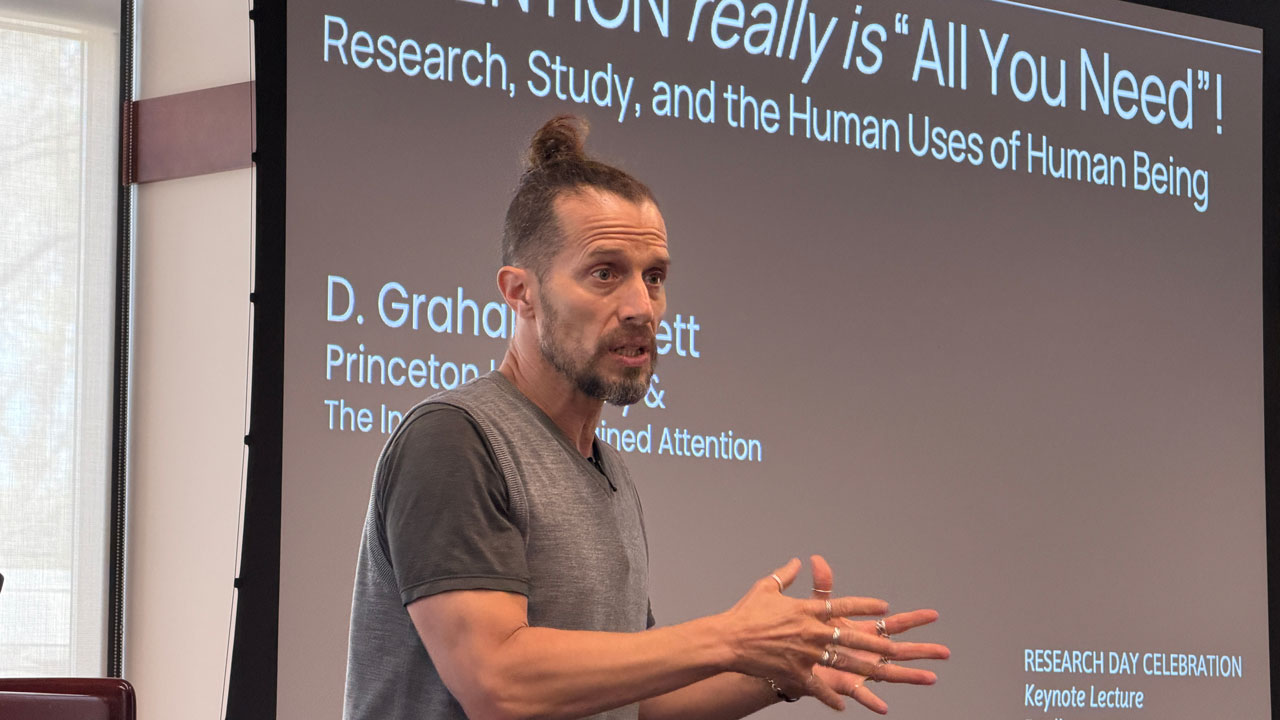
Then Princeton professor D. Graham Burnett, PhD, capped off the event with a keynote on AI and the commodification of human attention.
Protecting our attention against ‘human fracking’ in the tech age is critical.
Burnett, an “attention activist” and author of the much-discussed New Yorker article, “Will the Humanities Survive Artificial Intelligence?,” compared the dominant industry 25 years ago—petroleum—to the most lucrative sector now: tech. These unregulated companies, he said, are essentially in the business of extracting our attention, which he likened to “human fracking.” He offered various ways to protect this human resource, such as establishing shared goals around technology use and using the 1970s environmental movement as a guide to reclaim the “psychosocial environment.”
