

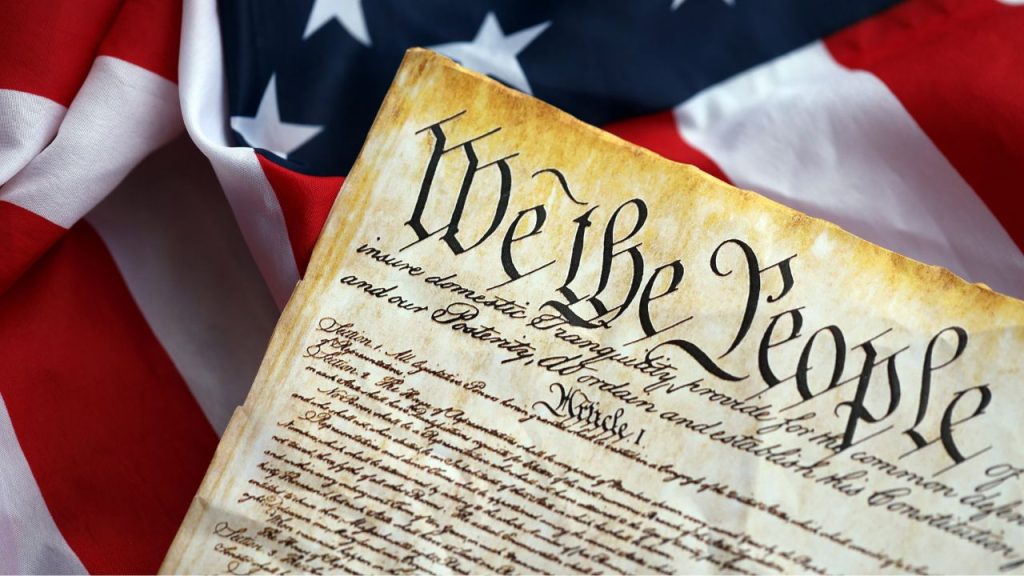
Two hundred and fifty years after the United States declared its independence, the Constitution remains our nation’s governing blueprint. It has outlasted war, economic crises, and profound technological and social change. But the document drafted in 1787 was written for a very different America than the one that exists today.
As the nation marks its 250th birthday, Fordham scholars reflected on the Constitution’s strengths, as well as the challenges it presents in our 21st-century democracy.
Made to Last, Hard to Change
The Constitution was designed to be difficult to change, according to professor Julie Suk, PhD, who teaches courses in constitutional law at Fordham Law. Amending it requires approval by two-thirds of Congress and ratification by three-fourths of the states, a deliberately high bar that has resulted in just 27 amendments.
That stability has helped the Constitution endure, but it has also made it difficult for our democracy to adapt, Suk said, creating pressure on society that has at times led to violence and once civil war.
“If you make it really hard to change something legally, then the only way you could change it is by having a violent revolution,” said Suk, the Leonard F. Manning Professor of Law. “What law does is make it possible to make changes and evolve through peaceful means.”
Suk, whose scholarship focuses on constitutional amendment and reform, says the challenge is finding ways to adapt the nation’s governing framework, despite the arduous amendment process.
“This is a problem that I’m probably going to be spending the rest of my career working on,” said Suk, who serves on the American Constitution Society’s academic advisory board.
Checks and Balances Under Strain
The Constitution divides power among the legislative, executive, and judicial branches so that no single branch can dominate the others. Martin Flaherty, the Leitner Family Professor of International Human Rights Law at Fordham Law, said the system has been one of the Constitution’s greatest strengths. By giving each branch the ability to check the others, the founders sought to prevent any one person or institution from accumulating too much power, Flaherty said.
“The founders expected Congress to try to maximize congressional power, and the president to maximize executive power, and, as Madison said in Federalist 51, ‘ambition will check ambition,’” Flaherty said.
But that system works only if each branch is willing to defend its own constitutional role. The rise of political parties—which the founders never envisioned—has shifted lawmakers’ loyalties away from Congress as an institution and toward party leaders, Flaherty said. Gerrymandering has further reinforced partisan incentives, and Citizens United, a Supreme Court ruling that protected campaign contributions the way we protect free speech, has made meaningful campaign-finance restrictions difficult, further weakening Congress’s intended role as a democratic body.
The Second Amendment vs. Modern Weapons
Few parts of the Constitution generate more debate today than the Second Amendment, which protects the right to bear arms.
But “arms” meant something very different to the founders, according to Saul Cornell, the Paul and Diane Guenther Chair in American History. When the amendment was ratified in 1791, firearms were single-shot muskets that were far less accurate and less deadly than modern guns, said Cornell, one of the nation’s foremost experts on the Second Amendment.
“If Adam Lanza had walked into Sandy Hook with a musket, everyone in that school might still be alive,” said Cornell.
The problem is less about the founders’ intentions than about the ways later generations have interpreted them, Cornell argues.
“Our current Supreme Court does not seem to understand the culture and mindset of the people who wrote the Constitution,” said Cornell, whose commentary on the Second Amendment is featured in a new Netflix documentary. “Their version of the Second Amendment is sort of like if you ran the Constitution through a very bad version of Google Translator. It’s an almost literal—and in some places quite silly—version of the text.”
The Constitution in the 21st Century
Despite these challenges, Suk pointed to moments in American history when the nation adapted to profound crises while preserving its constitutional framework. The Civil War ultimately produced some of the Constitution’s most consequential amendments, abolishing slavery and expanding civil rights, she said.
The scholars shared one conviction: the Constitution has never been a finished project. As America celebrates the 250th anniversary of its founding, the debate over how best to interpret, preserve, and when necessary, improve it remains as alive as ever.
