

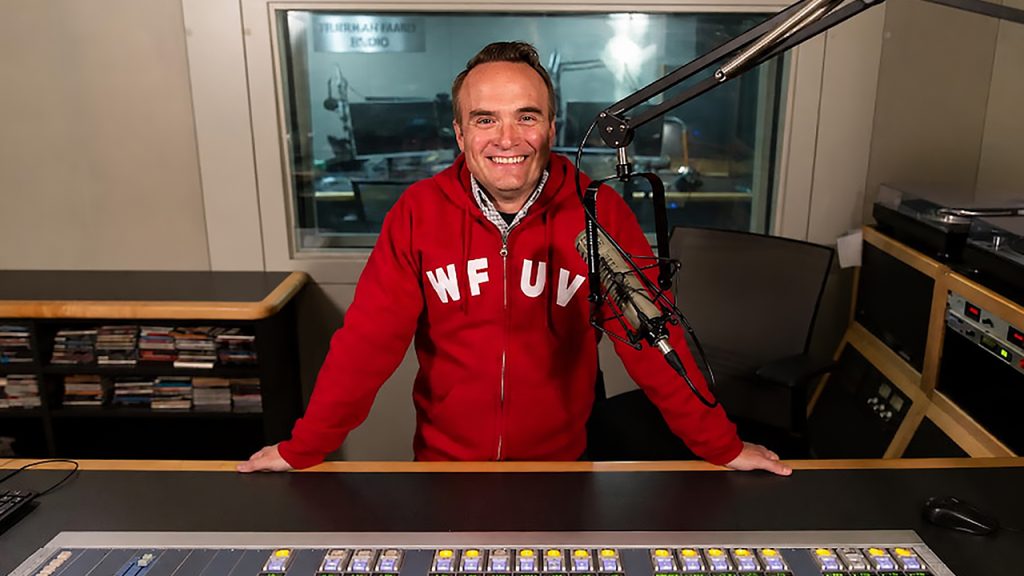
Rich McLaughlin’s career has followed an arc he never would have imagined as a Fordham undergraduate working in music and sports at WFUV.
Earlier this month he was named general manager of the station, and sees it as a privilege to lead “the very place that helped shape my future,” he said.
He brings deep experience to the role: as a Fordham student he was mentored by WFUV greats Rita Houston, Bob Ahrens, Meg Griffin, and Chuck Singleton, his predecessor as general manager. After graduating from Fordham in 2001, he worked on the cutting edge of music broadcasting at Amazon Music, iHeartRadio, and Sirius Satellite Radio, earning an MBA from Fordham along the way. Since returning to WFUV in 2021, he has served as program director and associate general manager, and took over as interim general manager following Singleton’s retirement in June.
While settling into his new role, McLaughlin sat down with Fordham Now to talk about all the exciting things he sees in store for Fordham’s public media station.
What do you look forward to most in your new role?
What excites me most is the opportunity to build on WFUV’s remarkable legacy. It has the kind of distinct identity and deeply personal relationship with its audience that are increasingly rare in media. We have a passionate team, a loyal community of supporters, and an unmatched connection to New York City’s music scene. Our mission now is to build on those strengths and ensure we’re as relevant to the next generation as we’ve been to generations before.
Can you describe your vision for WFUV’s future?
My vision for WFUV is based on three priorities. First is relevance, which means evolving how WFUV creates and shares its content to engage audiences wherever they are. Next is integration, or strengthening WFUV’s relationships with Fordham as well as New York’s creative community and the music industry.
Algorithms can predict what you want to hear, but great radio can introduce you to something you never knew you needed.
And the third is sustainability, which means making sure our people, resources, and operating model are positioned for long-term success. It’s not about changing what makes WFUV special, it’s about finding new ways to make that matter even more. That means investing in our people, strengthening how we work together, and making thoughtful decisions about where we focus our time and resources.
We occupy a unique position—we’re part of a world-class university, located in the media capital of the world, with deep connections to one of the most vibrant music communities anywhere. I see tremendous opportunities to bring those worlds closer together through storytelling, artist conversations, live performances, and cultural partnerships.
Do you foresee new opportunities for students at WFUV?
Absolutely. The industry is rapidly evolving, and audiences have more content options than ever, from radio, streaming, and podcasts to video and social media. The future of radio is not just about what comes out of the speakers, it’s about the relationships we build across all of these platforms. Our student training needs to reflect that, from music to news and sports. In some areas, like social media, there’s a lot the students can teach us as well, which is really cool and exciting, I think.
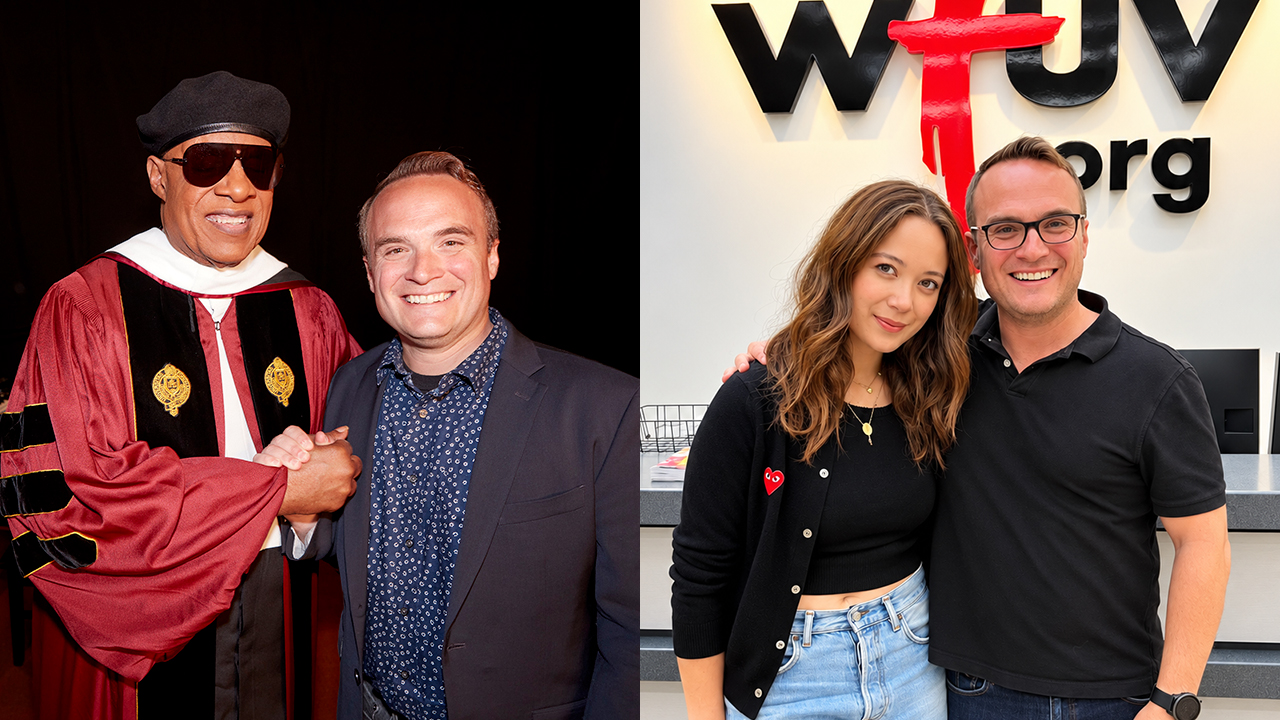
One of my priorities is to extend opportunities for students to work across disciplines, from broadcasting and journalism to digital content, video production, marketing, and audience development. We’re exploring facilities upgrades to give students the best hands-on experiences, and I’d like to create more connections between students and our network of alumni working in journalism, sports broadcasting, and other media.
How will your experience beyond WFUV inform your approach?
I’ve been fortunate to experience the evolution of the audio industry from several different perspectives: satellite radio at SiriusXM, digital radio at iHeartMedia, and global music streaming at Amazon Music. At SiriusXM, I was part of the team that built its original content platform. At iHeartMedia, I helped create one of the first significant podcast platforms. Those experiences taught me that while technology will continue to change, the fundamentals remain remarkably consistent: understand your audience, create exceptional experiences, and build meaningful connections.
In today’s digitized media landscape, what is the role of independent voices like WFUV’s?
We live in an age of unlimited content but increasingly limited human connection. That sense of connection and community is something that independent radio does so beautifully. Algorithms are remarkably good at predicting what music we might like, but they can’t replicate the experience of discovering music through a familiar voice whose taste, curiosity, and judgment we’ve come to trust. Algorithms can predict what you want to hear, but great radio can introduce you to something you never knew you needed.
Who are some of your favorite artists who have appeared at WFUV?
There are so many! Gorillaz, boygenius, Kamasi Washington, Mitski, and Mumford & Sons immediately come to mind. These are artists who have built passionate audiences. But what excites me just as much is discovering and championing next-generation artists like beabadoobee, Jesse Welles, Silvana Estrada, Fantastic Cat, and Laufey.
That’s one of the things I love most about WFUV. We celebrate artists who have already made their mark while introducing those who are just beginning to make theirs.
