

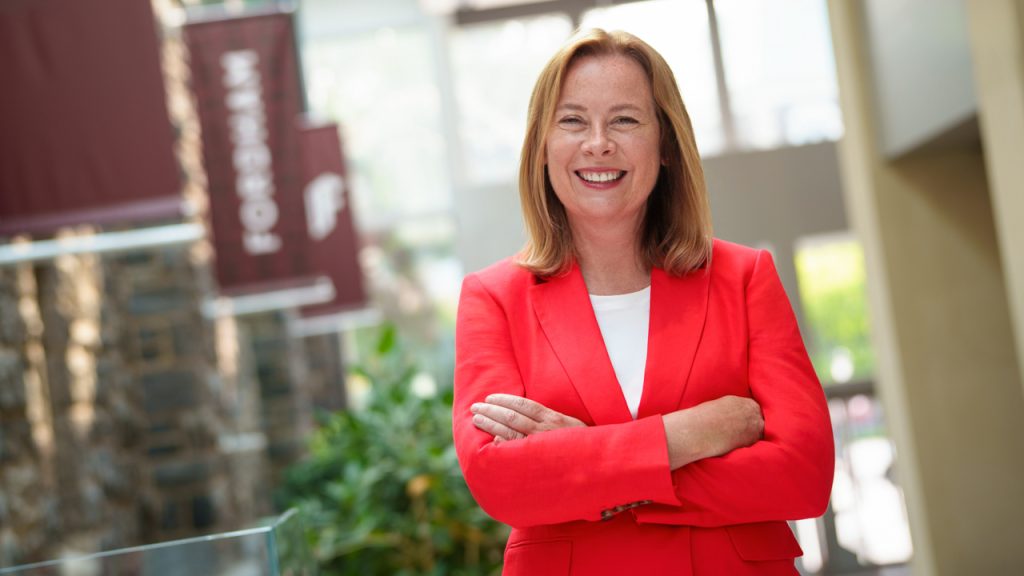
KerryAnn O’Meara, PhD, joined Fordham as the new provost and senior vice president for academic affairs on July 1. She is a nationally recognized scholar on academic careers and reward systems, as well as organizational change in higher education.
O’Meara has held academic leadership positions at the University of Maryland and at Teachers College, Columbia University, where she most recently served as vice president for academic affairs and provost. Her scholarship has been used widely by academics to create better places to learn, work, and thrive.
Fordham Now sat down with O’Meara to learn more about her vision for the role.
What drew you to Fordham at this point in your career, and what convinced you this was the right place for your next chapter?
So there is this term the Jesuit Volunteer Corps uses—being “ruined” by a Jesuit education. That was me. I was ruined by incredible mentoring and my liberal arts education when I was 18. And I did not “recover.” My Jesuit education has been foundational in every part of my life, including how I approached my scholarship, teaching, and leadership. And so I was drawn to Fordham’s Jesuit mission. President Tetlow’s vision and leadership were also a major pull, as was the University’s strategic plan.
I also love New York City and the ways that Fordham’s campuses are of, with, and for the city. In all of my interactions here—with students, faculty, administrators, public safety officers, and facilities staff—I felt a deep sense of community and wanted to be a part of it.
As you begin meeting with faculty, staff, and students, what are the questions you’re most eager to ask, and what do you hope to learn?
I want to hear people’s Fordham stories—what brought them here and what keeps them here. I also want to know what they are working on right now, whether it’s a new book, a research study, or a new program.
I am entering a moving river, and I want colleagues to help me understand some of what came before that shaped the initiatives we have underway. I also want to hear what they experience as challenges and the possibilities they see for addressing them.
One of the strategic plan’s important goals is to expand science and technology programs and facilities, drawing on Fordham’s Jesuit mission and its strengths in the humanities. You shared that this is something that excites you. Can you tell me more?
Yes, it is an exciting time to be at Fordham for many reasons, but this is a major one. Discovery and science have always been key components of Jesuit education. The very first Jesuits were explorers who sought to uncover how things work—the stars, new plant species, manners of human interaction and citizenship, and health and well-being. They shared this curiosity and desire to learn with their students.
We know the complex challenges that await Fordham graduates require skills in discovery, interdisciplinary thinking, and ethical decision-making. Fordham is seizing this moment to support the excellence that exists in our current discovery and science programs while also imagining and creating new opportunities for discovery in areas like climate, health and wellness, and the ethical use of AI. All of this is guided by the Ignatian belief that we seek knowledge not only to deepen our understanding, but to make the world a better place.
From your perspective, what are the ingredients that allow faculty to thrive, and how can the provost’s office help create those conditions?
I study academic careers and the systems that allow faculty to be successful, so, if you’ll allow me, I’ll get a little nerdy here.
Four themes emerge most often: First, faculty need agency to accomplish their personal and professional goals. They also need opportunities for continual learning—as scholars, but also in other areas such as teaching and the many leadership roles they play. They need strong professional relationships and networks, on campus and off. And finally, they need feedback and recognition for their work.
There are many ways to ensure faculty members get what they need. Department chair and colleague support, orientation, mentoring committees, and learning communities are some examples, as are effective policies that guide workload and recognition while providing resources for collaborative and interdisciplinary scholarship. There are some very innovative initiatives underway at Fordham, and I look forward to learning how we can better support faculty teaching, scholarship, and professional growth.
Artificial intelligence is rapidly reshaping the way students learn, and will factor heavily into whatever career paths they choose. How do you think Fordham can help students seize the opportunities AI presents while using it responsibly?
Fordham has really stepped forward as a leader in this space, from the University’s Ethical and Applied AI Hub, to an upcoming conference on AI and Ignatian Spirituality, to the many conversations taking place across our colleges and schools.
I recently listened to a webinar on Pope Leo XIV’s encyclical Magnifica Humanitas, which focused on AI and human flourishing. One idea stood out to me: where we place our attention. Pope Leo argues our attention should remain fixed on human dignity first. He asks how we can become “wise architects” of AI so it advances distinctly human goals.
I believe that’s exactly the approach Fordham is taking: helping students embrace AI as a powerful tool while ensuring they have the ethical grounding and discernment to use it in ways that serve the common good.
On a lighter note: You mentioned being an English major, a lifelong reader, and a big Lord of the Rings fan. What are some of your favorite books?
So many! I love Mary Oliver’s poetry and am reading a book she wrote on the writing process. I also like a good beach book with strong characters, so I just finished Joshlyn Jackson’s newest book, Missing Sister. Growing up, A Tree Grows in Brooklyn was one of my favorites, as several characters reminded me of my family.
This interview has been condensed and edited for clarity.
