

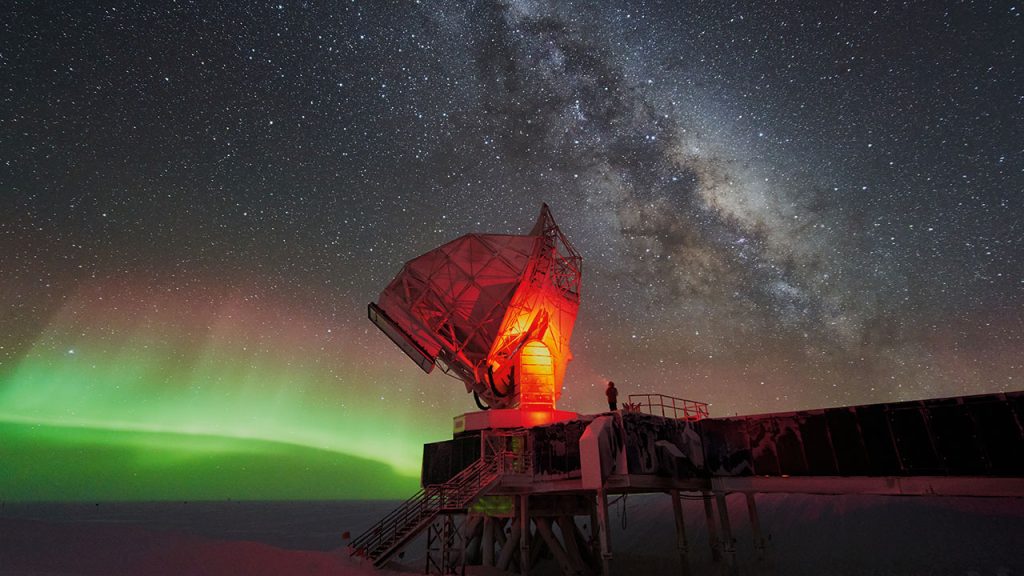
The human quest to understand the nature of the universe and our place in it has changed dramatically since Ptolemy thought the cosmos revolved around Earth. We now know that our Milky Way is just one of hundreds of billions of galaxies, and cosmologists generally accept that the universe began about 14 billion years ago with the Big Bang and has been expanding ever since.
But the matter is far from settled, as cosmologist Joshua Sobrin ’11 can attest. The standard mathematical model scientists developed in the late 1990s to explain the workings of the universe, known as Lambda-CDM, has been showing signs of strain lately because increasingly precise observations of distant phenomena do not line up with the model’s predictions. Is the universe expanding uniformly as Lambda-CDM predicts, or are variations from the model signaling new, uncharted physics?
Sobrin, who majored in physics and religious studies at Fordham, is one of the young scientists whose research could help answer these profound questions. As a doctoral student in experimental cosmology at the University of Chicago and then as a Lederman fellow at Fermi National Accelerator Laboratory outside Chicago, Sobrin has been deeply involved in conducting cosmological research with the South Pole Telescope. This federally funded radio telescope takes advantage of the pole’s extraordinarily clear, dry conditions to detect the cosmic microwave background, the wisps of radiation left from the Big Bang.
For nearly 30 years, we’ve relied on Lambda-CDM to understand how the universe has evolved since the Big Bang. But now you’re seeing some cracks in that foundation. What’s happening?
It’s a really exciting time in cosmology. The Lambda-CDM model has been very successful in explaining the cosmic microwave background and the evolution of the universe.
But, thanks in part to the South Pole Telescope, our experiments are getting more sophisticated, and for certain things, we’re starting to see experiments give us different answers than the model. One example of this is trying to understand the expansion rate of the universe. According to Lambda-CDM, we get one number. If you go out and actually measure the expansion rate by looking at things like supernovae and certain types of stars, you get a number that is quite close. But as more experiments get done, there’s starting to be this tension between those two approaches.
What are the implications of this tension?
Maybe that’s an indication that there’s something wrong with the model. And if the model is wrong, that means that our physical understanding of the universe is wrong, or maybe incomplete. It wouldn’t be the first time in human history where there’s been a shift, where the universe is actually quite different than we thought it was. Now, I’m not saying we’re at that moment yet, but that’s why I think it’s such an exciting time. We’re designing experiments and making measurements that are really going to test some of these assertions that we have about the universe.
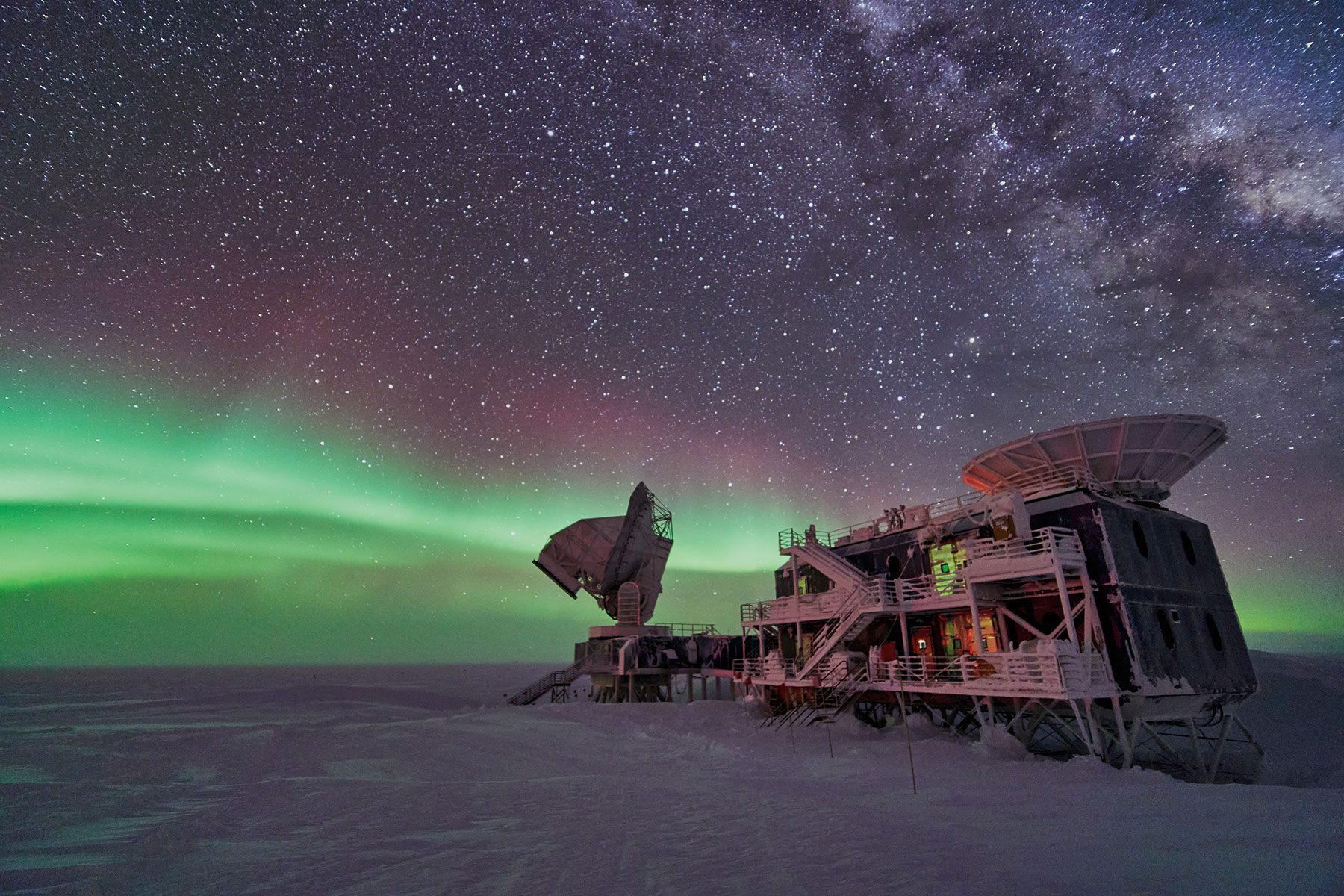
You’ve been part of a team of scientists who are using the South Pole Telescope to study clusters of galaxies that formed in the period between the Big Bang and now. How will the results of that research inform the debate about the standard model?
One way to tease out what’s going on is to try to get a better understanding as to what our universe looked like as it went from time zero to 14 billion years with these galaxy cluster surveys. Right now, we’re on the verge of a monumental advancement in the quality of cluster surveys. We’re finding more and more clusters and cataloging their abundance across our universe’s history. And this is going to really test the model’s ability to explain dark energy, gravity, and structure formation.
You majored in both physics and religious studies at Fordham. What roles do science and religion play in addressing fundamental questions about the universe?
I’ve taken the perspective that the questions are the questions. Who are we? Why did it happen that way? One could go as far as to say, “Who made it happen that way, or what made it happen that way?” Historically, humans have answered those questions in lots of ways.
I try to push back when people say, “Well, only science is evidence-based.” And that’s absolutely true. But I think a religious cosmology has elements of being evidence-based in the sense that any religious explanation that was completely disconnected from the human experience would not be a very satisfying theology.
At Fordham, I was very interested in trying to understand what it is that’s satisfying about the various sorts of religious or philosophical or scientific explanations for these really deep questions. I enjoyed my time at Fordham trying to better understand the different attributes of these types of explanations.
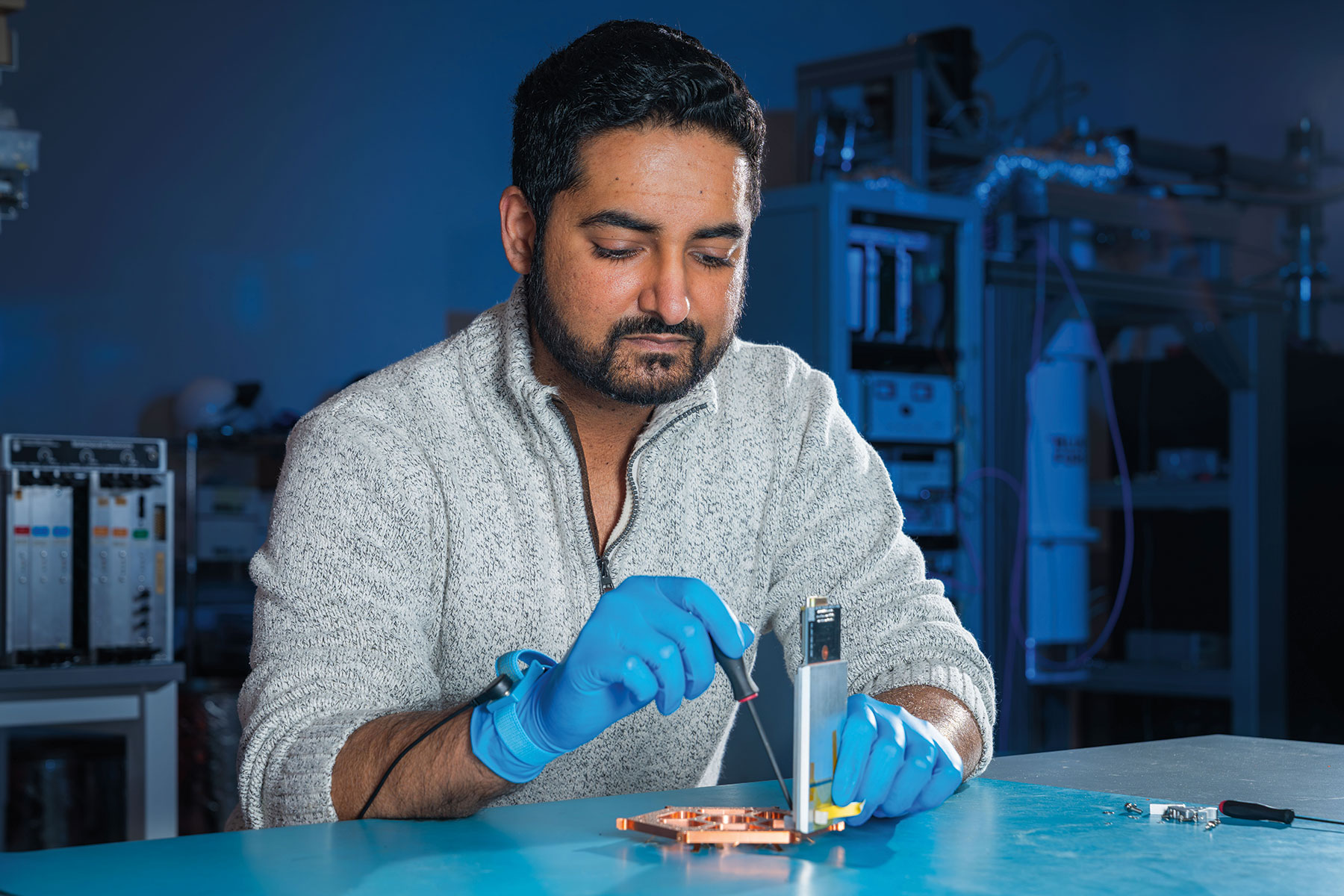
In addition to your research work at Fermi, you also teach physics, and you’ll be joining Villanova University as an assistant professor in the fall. How does being an educator fit into the larger framework of your life?
The short, maybe unsatisfying answer to that question is I teach because I love to teach. But I also think some people see scientists or physicists as this priestly class. And there’s a big downside to that, intrinsically, for society. So, I also teach because I think it’s important to empower people so that they can access the tools that we use—rigorous analysis, quantitative assessment, clarity of argument.
I’m very aware that most of the people I teach are not going to become cosmologists. But what I do my best to convey to my students is that by learning a bit of physics, you will build the confidence and the self-efficacy to come at the problems that are interesting to you in new ways, and it might be in very useful ways.
Interview conducted, edited, and condensed by Stevenson Swanson
