

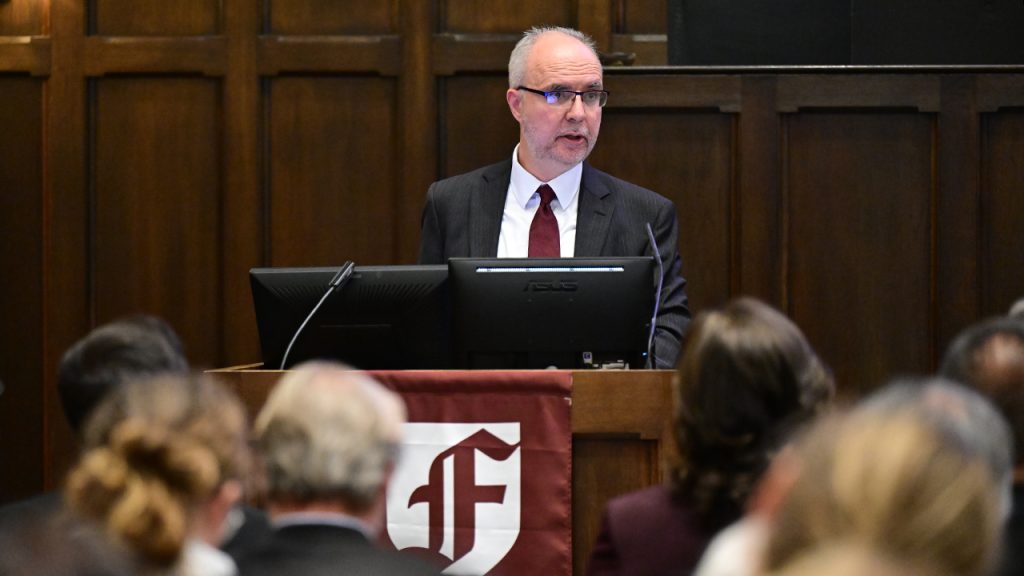
Nearly 1,000 years after the Catholic and Orthodox Christian churches split apart, the Orthodox church should accept some measure of authority from the pope to help bring the two churches closer together, a scholar from the University of Oxford argued during an appearance at Fordham.
Starting with a wry joke about his “very uncontroversial” topic, theologian Paul L. Gavrilyuk, PhD, proposed two changes that he said would heal divisions within the churches: He called for restoring the right of Orthodox bishops to appeal their differences to the pope, which would allow him to settle the disputes.
And he also proposed that the pope be able to convene councils of Orthodox leaders to work communally on issues that divide them, an approach known as synodality, said Gavrilyuk, the inaugural Michael Huffington Chair of Eastern Orthodox Christianity at Oxford University.
A role for the pope is needed because Orthodox efforts at synodality are unlikely to overcome the church’s internal conflicts, such as the current schism between the Greek Orthodox and Russian Orthodox churches, he said.
“The unifying role of papal authority” has made synodality more successful in the Catholic Church and can help it advance in the Orthodox church as well, said Gavrilyuk.
‘An Antidote to Polarization’
Gavrilyuk came to Fordham to deliver the Economos Orthodoxy in America Lecture, a signature annual event of the University’s Orthodox Christian Studies Center. Pope Leo has hailed synodality as “an antidote to polarization,” he said, noting that the Catholic Church embraced the practice under Pope Francis as the church moved away from top-down decision making and toward a more participatory process.
He portrayed his proposed changes as a way to better serve the faithful of both churches.
“What we’re discussing here are human means of rendering the church more transparent to the grace of God,” he said.
“The church means very little if it loses focus on its main function, which is to serve as a sacramental means of salvation and initiation of people into the life of the Triune God,” he said.
Progress Toward Unity
The Catholic and Orthodox churches have been making progress toward greater unity, said George Demacopoulos, PhD, co-director of the Orthodox Christian Studies Center, in an interview. In the 1960s they lifted their mutual condemnations of each other, and they’ve been speaking with a common voice on issues like war, poverty, and refugees, with the academic work done in centers like Fordham’s “provid[ing] some of the ground cover for that sort of thing to happen,” he said.
But a more pronounced unity would remove conflicts at the interpersonal level—for instance, providing sacramental unity, “so that if a Roman Catholic is married to an Eastern Orthodox person, they can commune at one another’s parishes,” he said. Other issues include the role of women and LGBTQ faithful, said center co-director Aristotle Papanikolau, PhD.
An Orthodox Tradition of Synodality
Synodality is a way of addressing such potentially divisive issues. The Orthodox church has had a long tradition of synodality that “has kind of broken down because we lack the mechanism to force bishops who don’t want to sit next to other bishops,” Demacopoulos said.
In the Catholic church, by contrast, the pope is essentially a monarch with final say on administrative and political matters, Papanikolau said. “Someone having the power to initiate a group gathering could help set a tone” that bishops feel they should follow, he said.
Tracking Trends in Orthodoxy
In his lecture, Gavrilyuk noted that because of local Orthodox churches’ isolation, it’s challenging “to understand global concerns and trends within Orthodoxy.”
“We have to rely on pollsters with usually no affiliation with the Orthodox church,” such as the Pew Research Center, he said.
He suggested the Orthodox Christian Studies Center could help in this area. And he referred to the center as “the most impactful educational initiative undertaken by the leaders of the Orthodox church in this century.”
