

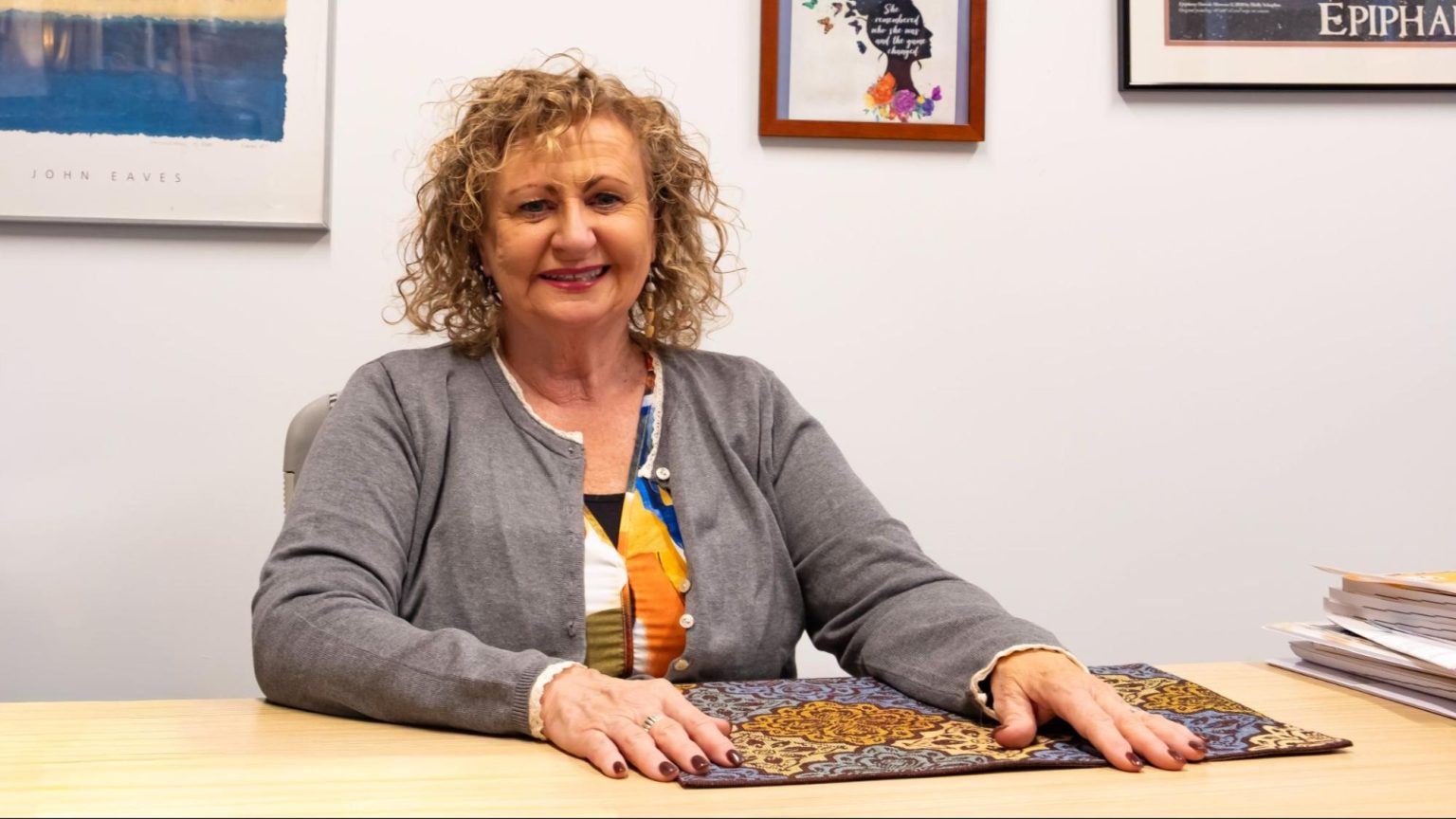
Carol Gibney’s Rose Hill office is filled with symbols of her passion for pastoral counseling. “Epiphany” is written across a print of St. Ignatius of Loyola, a freestanding wooden cutout spelling PEACE sits on a shelf, and pops of inspirational quotes affirm the power of gratitude and self-discovery.
“Spirituality is such a gift and a strength,” said the director of solidarity and leadership for Campus Ministry. “And to integrate that into your everyday life is the greatest gift that each person can have.”
Bringing this gift to Fordham students, faculty, and staff as they find their spiritual paths is “privileged work,” she said. “I’m so grateful to be along on this journey with people in some small way.”
Below she explains how she joined Campus Ministry 23 years ago, why service means more than volunteering your time, and what Ignatian spirituality can teach us about love.
Her Lucky Break
Gibney was completing her social work degree at Fordham’s Graduate School of Social Service when a professor (now a dear friend, Vincenza Corcoran) asked her what she would like to do in her second year. Corcoran pulled out a fax that advertised a yearlong, paid internship in Campus Ministry for an MSW student. It appealed to her on a gut level.
“I said, ‘Oh my God, I’ll take it. What’s Campus Ministry?’ I had no idea! So I call myself the accidental campus minister.”
Her Celestial Cheerleaders
Though unfamiliar with Fordham’s pastoral department, Gibney grew up in a religious, Irish Catholic home where her mother was president of their parish’s Altar and Rosary Society, not far from Rose Hill. When she was hired in 2002 (she joined Fordham full-time in 2003), “My parents were both in heaven, probably cheering me on from that celestial cheerleading pit,” she said.
Leading Others Through the Spiritual Exercises
One of Gibney’s mentors, Joe Currie, SJ, the late former director of Campus Ministry, encouraged her to do the 19th Annotation of the Spiritual Exercises—a roughly eight-month adaptation of Ignatius’ 30-day retreat. “The Spiritual Exercises really helped me clarify my place in the world.”
She then completed her training as a spiritual director and began accompanying students, faculty and staff on the spiritual exercises. (This year Gibney is leading employees through a condensed, eight-week version. The next session begins in spring—reach out to her if you’re interested. The full retreat will be offered next academic year.)
“I’ve been trying to offer that to folks each year.”
Once You’re a Pickle
Gibney loves to help students discover who they are and what they were called to be.
“I always suggest, pay attention to what breaks your heart and what fills your heart with joy. That’s your divine inviting you to really pay attention.”
Once students start to recognize “this is what I love, this is what really disturbs me, these are the gifts that I have—that’s vocation,” said Gibney.
There’s no going back once that process of self-discovery begins.
“I like to say, once you’re a pickle, you’re never a cucumber again.”
Interior Freedom = Love
At the core of St. Ignatius’ teachings is the concept of interior freedom, said Gibney. Rather than being ruled by our fears or attachments, Ignatian spirituality allows us to recognize “that unconditional river of love that flows within each one of us,” said Gibney. “Once you tune into that, you can look at the world through the eyes of love.”
The Real Housewives of Yonkers
Expressing gratitude is an important part of Gibney’s daily life. She and a group of 10 girlfriends—who she affectionately calls “the real housewives of Yonkers”—keep up a gratitude text chain. “We’ve raised our families together, we’ve been together through all the stuff in life. And every single morning we text each other three things we’re grateful for.”
Service Is Community Building
The Pedro Arrupe Volunteers program, which Gibney has led for the past six years, goes beyond, say, signing up for a slot at a soup kitchen. Their “engagements”—such as their annual Halloween event that brings local Bronx families to campus—begin and end with prayer and give Fordham students a chance to connect with the surrounding community. “Service shouldn’t be transactional,” said Gibney. “It’s more like accompaniment or kinship.”
The Key to Everlasting Youth
Outside of Fordham, Gibney shares her social work and pastoral expertise in a program called the Good Wolf Project, which teaches young adults how to apply the science of neuroplasticity to improving their lives. “It’s a beautiful, amazing program, and I learned something new,” she said, through participating in it.
Her former mentor, the late Mary Ann Quaranta, dean emerita of GSS, would be proud. “She said, ‘You have to be a lifelong learner. When you treat every day as an awakening, you’ll never grow old, you’ll just keep growing.’”
