

English professor Julie Kim, PhD, teaches students in her Imagining Nature class to pay attention to the world around them—a crucial skill “in this age of digital dominance,” she said.
“We’re spending all of our time on our phones and computers. And so the goal of the class is really to provide an antidote to that and to get students to realize that they might be able to get something out of nature that they can’t get from their devices,” said Kim, whose scholarship focuses on nature writing and natural history.
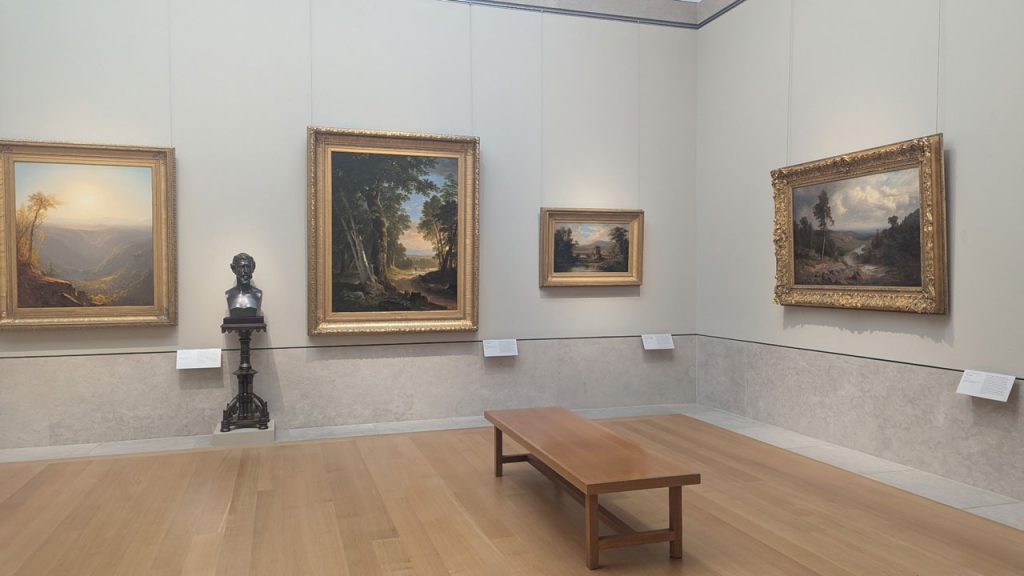
She asks students in the course to examine their own understanding of the natural world, not only by reading well-known nature writing, but also by getting out of the classroom. Visits to the New York Botanical Garden and the Metropolitan Museum of Art allow them to closely observe nature, whether outdoors or through the art of landscape painting.
At the NYBG, she asks students to fill a nature journal with their observations and botanical illustrations during self-guided visits to the Thain Family Forest, located inside the garden, which is free to enter for Fordham students and employees.
“The whole idea,” she said of the journals, “is to pay closer attention to nature, and see how that actually changes the way you’re thinking and feeling.”
At the Met, she takes students on a tour of American landscape paintings to do some “close looking,” a practice popularized by influential art historian Jules Prown. For some, the visit doubles as an introduction to this New York institution.
“Every time I’ve done it, I’ve had at least one student tell me, I’ve never been to the Met before,” said Kim. “You cannot say you really know New York City if you’ve never been to the Met, so I feel like it’s a crucial part of their education.”
While observing plein air art, Kim looks for “different scales of attention”—the minute details within the grand scope of a dramatic landscape. After the museum visit, she said, “I think students realize that they can apply these skills of attention anywhere to achieve insight.”
Try it yourself: Take a close look at one of the paintings Kim observes with students, a 1863 work by John Henry Hill, found in gallery 761 of the Met. What do you see?
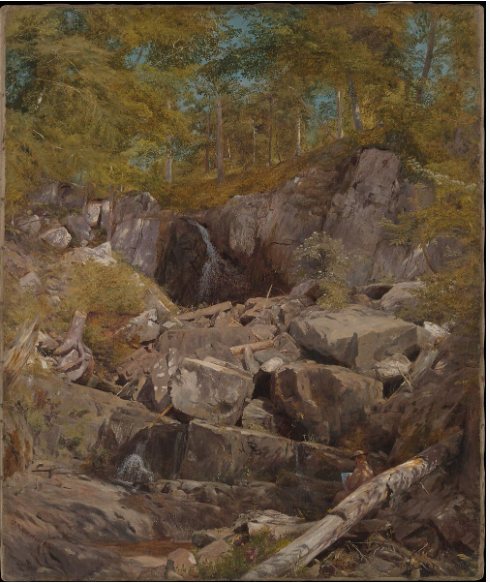
Do you spot the person leaning against the fallen tree? In his faithful reproduction of this Hudson Valley scene, Hill included a fellow artist sketching nature—a common feature in Hudson River School paintings and other 19th-century landscape art.
“They’re usually just a tiny piece of this grand landscape, which, I think, is the point—that nature is the real subject and much more interesting and important than the human who is occupying it at the moment,” said Kim.
To continue your own tour of Kim’s favorite paintings in the American wing of the Met, be sure to spend time with “Summer Woodlands” and “Ducks in the Woods,” by Julie Hart Beers, the first professional woman plein air painter; “Clouds” by Thomas Cole; and “Lake George” by John Frederick Kensett.
