

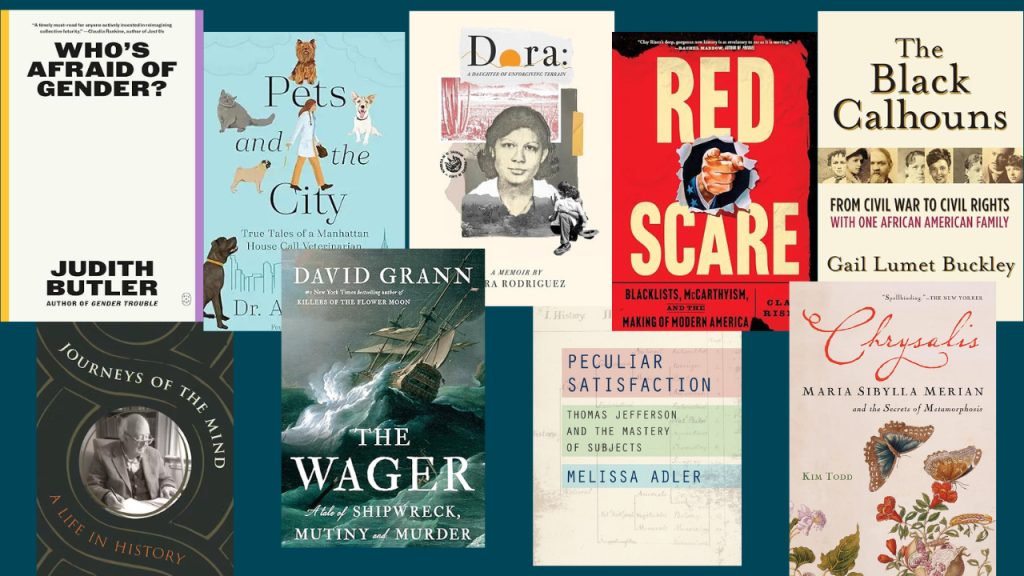
Nonfiction, biographies, and memoirs encourage us to step back in time—or into someone else’s shoes—to understand our present situation with more empathy and wisdom. We tapped the Fordham community for recommendations in these genres that will stand up to summer’s distractions. Read on for nonfiction that delves into pioneering women, mutinous men, and other true stories that are more fascinating than fiction.
The Naturalist Who Predates Darwin
A year after the release of his second novel Cochabamba, Fordham Spanish professor Guillermo Severiche, PhD, was already starting on his third. In his research, he discovered the “mind-blowing” biography, Chrysalis: Maria Sibylla Merian and the Secrets of Metamorphosis, which recounts the life of artist and naturalist Maria Sibylla Merian, who sailed from Europe in 1699 with her daughter to study insect metamorphosis in South America. “I am just amazed at the infinite stories that come up from her life, and especially from this journey,” said Severiche.
The Godfather of Late Antiquity
Instead of viewing the Dark Ages as a period of decline, Peter Brown saw a vital and complex time. “To rehabilitate lost centuries has been my particular joy,” the celebrated historian of late antiquity writes in Journeys of the Mind: A Life in History. His memoir recounts the “grand endeavor” of reimagining this period, as well as his childhood in Ireland, studiesat Oxford, travels to prerevolutionary Iran, and interactions with scholars like Michel Foucault. “He tells his own story with great wit and warmth,” said Center for Religion and Culture Director David Gibson, who is excited to be reading it during his summer travels.
A Veterinarian to the Stars
On a recent flight, Jacqueline Gross tore through Pets and the City, the memoir of a Manhattan veterinarian who makes house calls around the city—sometimes to celebrity pet owners. “It’s a must-read for anyone who loves cats and dogs,” said Gross, executive assistant to the vice dean for faculty affairs.
An Immigration Activist’s Inspiring Memoir
Dora Rodriguez’s firsthand account of forced migration in her memoir, Dora: A Daughter of Unforgiving Terrain, deeply moved Spanish professor Carey Kasten, PhD, who directs Fordham’s Initiative on Migrants, Migration, and Human Dignity. Rodriguez fled extreme violence in El Salvador in 1980 and endured a harrowing crossing of the Sonoran Desert to reach the U.S. What is so inspiring and impressive, said Kasten, “is that, after marrying, raising a family, and naturalizing, she comes back to immigration work, opening a shelter and a nonprofit to help other families, speaking to groups about her experiences.”
One Family and a Century of African American History
Joy Wingfield, assistant manager of legal recruiting in the Law School and founder of its Black Lives Matter book club, calls The Black Calhouns the rare memoir that reads like narrative fiction. Written by the daughter of singer Lena Horne, it covers six generations of one African American family during pivotal events, from the Civil War to the civil rights movement. “Gail Lumet Buckley details her family’s origins with such delicacy and precision,” said Wingfield.
A Real-Life Lord of the Flies
If you’re familiar with Killers of the Flower Moon by David Grann, the author’s most recent book, The Wager: A Tale of Shipwreck, Mutiny, and Murder, is even more of a thriller, says University Marketing and Communications Project Manager Nora Hogan. It tells the survival story of an 18th-century British navy captain and crew whose ship sinks off the Patagonian coast, leaving them stranded and lawless on a desolate island. “It’s a fantastic pick for anyone not planning to go on a cruise anytime soon,” she said.
Unpacking Attacks on Gender Identity
Gender and sexuality scholar Judith Butler’s most recent book, Who’s Afraid of Gender?, examines the root cause of political attacks on gender. Diane Detournay, PhD, senior lecturer of English, said it helped her understand “why gender functions as a target for authoritarian power, and the creative imagining we must undertake to challenge these attacks.”
A Red Scare Refresher
Biology professor Jason Morris, PhD, appreciated Clay Risen’s gripping history of the Cold War’s beginnings, The Red Scare: Blacklists, McCarthyism, and the Making of Modern America. The book, he said, explains the fears—founded and unfounded—that propelled extremist organizations and the careers of Joseph McCarthy, Roy Cohn, and President Nixon. “The challenges we face now are different, but the very human passions that challenge us are similar enough that this book helped me to understand some of what we are seeing in our political discourse now,” said Morris.
A Founding Organizer
As editorial director of Fordham University Press, Richard W. Morrison has often tried to organize his ever-growing “to-read” pile. So he was surprised to learn from author Melissa Adler that “our entire system of organizing knowledge, from the Library of Congress to archives and museums, is based upon Thomas Jefferson’s personal library.” She explores this history in Peculiar Satisfaction: Thomas Jefferson and the Mastery of Subjects, which Morrison edited. “At a time when the integrity of our institutions of learning and culture feels tenuous, it’s never been more important to understand the history of these foundational structures in order to defend them,” he said.
