

We asked the honorees of this year’s McGroddy Awards, which recognize innovative pedagogy, for the books and films they love to teach. What follows is a diverse mix of blockbuster hits, nuanced research, and cinematic gems. Be sure to thank your colleagues if you enjoy one of their picks!
World War Z
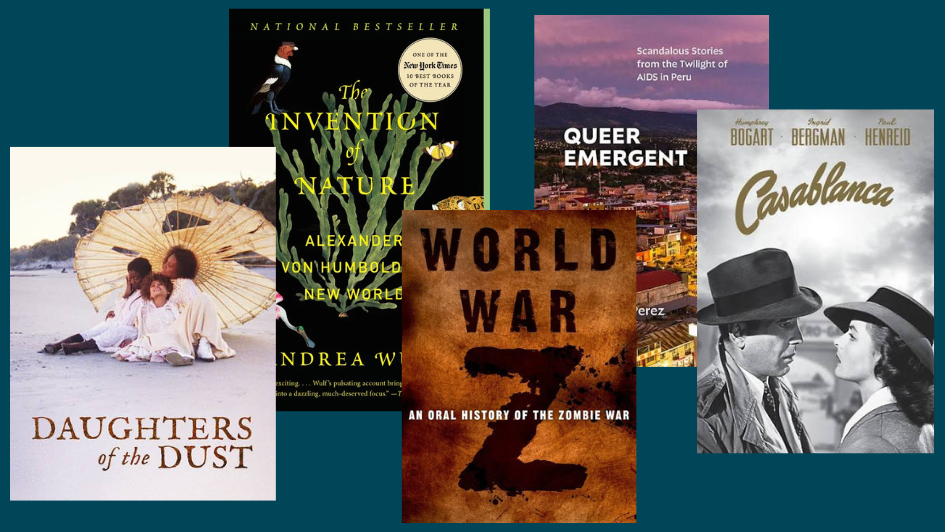
In the course Literature and Psychology of Disgust, psychology professor Dean McKay, PhD, often assigns reading that falls outside the empirical and theoretical research he typically covers. The book he especially enjoys teaching in this class, which he co-teaches with English professor Leonard Cassuto, is World War Z by Max Brooks. “While the title and opening passages are about a zombie war, it is decidedly not a zombie story,” said McKay. “The book is a sweeping account of human nature, moral judgments, and the ways we succeed or fail to overcome our basic anxieties. Students are routinely surprised to see these themes emerge in a book that at first glance would seem to be a horror story. It is not horrific, but instead rich with psychological concepts, and seeing the students realize how much depth there can be in stories like these is incredibly rewarding.”
Daughters of the Dust
Daughters of the Dust by Julie Dash is a film that communication and media studies professor Michele Prettyman, PhD, always teaches in her African American Cinema course. “It’s known for its stunning cinematography and its beautiful recreation of Black life from an often unseen historical vantage point,” said the film scholar. The 1991 movie portrays the last gathering of an extended Gullah family—descendants of enslaved Africans who preserved much of their language, religion, and traditions—on one of the Sea Islands off the South Carolina coast at the turn of the 20th century. “The Peazant family are deciding whether to stay on the island or migrate to the mainland to become part of the wave of Black modernity and migration, which was transforming the lives of Black Americans,” said Prettyman. “It reimagines the language of cinema, offering students profound insights into the power of independent and experimental filmmaking and an opening for thinking about how film artistry can bring history to life.”
Queer Emergent: Scandalous Stories from the Twilight of AIDS in Peru
In her course Feminist Ethnography, anthropology professor Natali Valdez, PhD, teaches Queer Emergent as a model for connecting critical anthropological methods to queer and feminist theories. Drawing on in-depth ethnographic research with gay and transgender communities in urban Amazonian Peru impacted by HIV/AIDS, author Justin Perez, PhD, illustrates how the lived realities of these local communities challenged the assumptions and practices of global HIV prevention efforts, Valdez said.
“This is a beautiful example of the importance of sustained ethnographic research to intimately understand the long-term impacts of global aid,” said Valdez, who invited Perez to discuss the book with her class last year. “The students reflected on how exciting it was to hear first-hand about the interpersonal relationships, friendships, and care involved,” she said.
The Invention of Nature
In her ecology and conservation courses, conservation geneticist Evon Hekkala, PhD, loves to assign The Invention of Nature by Andrea Wulf. The book traces the life of Alexander von Humboldt, who is known as the founding father of environmentalism. The 19th-century ecologist saw nature as a global, interconnected web, and was one of the earliest figures to warn of human-induced climate change.
“It’s a wonderful read,” said Hekkala. “It helps us connect many disparate aspects of our lives to nature and the study of the natural world.”
Casablanca
English professor Leonard Cassuto’s selection is not a book, but the legendary film Casablanca, which operates as both a love story between Rick Blaine (Humphrey Bogart) and Ilsa Lund (Ingrid Bergman), and a political allegory of America’s shift from isolationism at the start of World War II to its active engagement in fighting the Nazis.
“Very few of today’s college students know the movie at all, so it’s a total pleasure to introduce them to one of the most entertaining Hollywood films ever made,” said Cassuto, who teaches the film in a course he co-teaches with history professor David Hamlin on the history, literature, and film of World War II. “And there’s so much to discuss, not just about its meaning but also its form; its technical aspects, including its relation to film noir; and of course its historical context. Teaching it is a blast.”
