

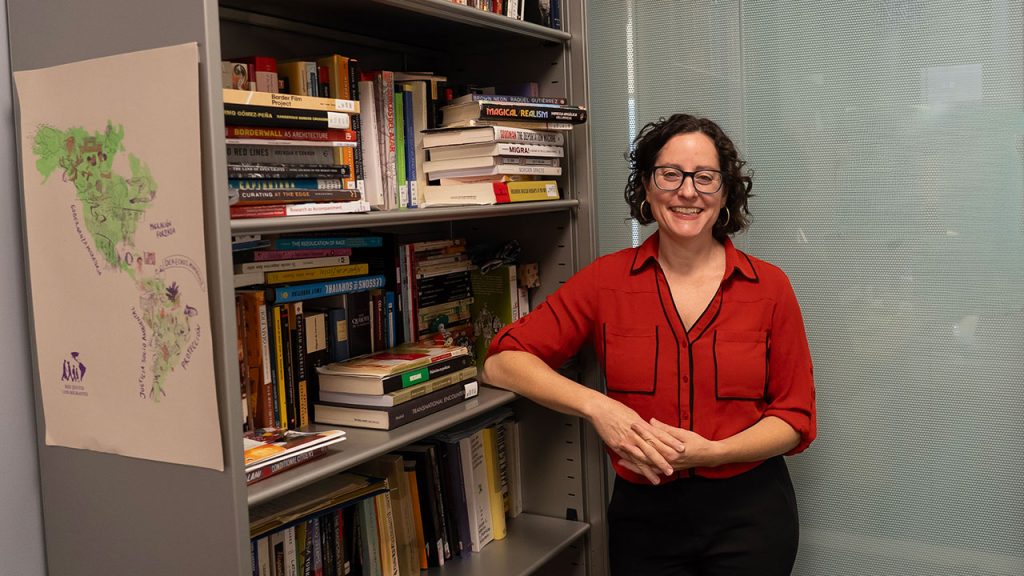
In 2019, Spanish professor Carey Kasten, PhD, took a faculty immersion trip to the U.S.-Mexico border that changed her understanding of migration and her work at Fordham.
“There are some people who really feel Fordham’s mission and live it and understand it. The border trip did that for me,” said Kasten.
Inspired by the experience, she helped create the Initiative on Migrants, Migration, and Human Dignity together with theology professors Leo Guardado, PhD, and Jim McCartin, PhD, to engage students and others in the challenges of global migration.
She now directs the initiative, which has secured grants that run through 2027 to support its work and 15 student interns a year. Some might assist migrants at a shelter on the border, or help immigrants in New York City apply for work permits or public benefits.
Beyond facilitating this student work, Kasten is also conducting research with neuroscience professor Alma Rodenas-Ruano, PhD, on the health impacts of prolonged separation between indigenous Mexican parents and their children who migrated to the U.S. As part of this research, the two are working with the Jesuit-run Radio Huaya, a rural Mexican radio station and social justice organization that is trying to help these parents visit their children after decades apart.
Below, Kasten spoke about her research, how her work shows up in class, and what students learn on trips to the border.
What was your impression of your first immersion trip to the border?
I remember before the trip thinking it seemed like “voluntourism.” But the idea is that you’re going there to learn. You get to witness what people are doing and it is exceptional. My takeaway when I came back was that students need to go on this trip. And then I led the student trip for three years.
What is the border trip like for students?
Students spend a week with the Kino Border Initiative, a Jesuit-affiliated organization in Ambos Nogales that advocates for migrants, humanitarian aid, and education on both sides of the border. Students serve food and work with the migrants at their shelter. They also meet with border patrol agents and ranchers.
The idea is to get different perspectives, and it really humanizes all of those sides for students. They often come away with this sense that what they see on the ground is different than the conversations that are happening at home—that these are real people who are just trying to do better.
Radio Huaya is not your typical radio station. How did they become a research partner?
I think here in the U.S. we don’t understand the idea of a radio station that does social justice outreach and care for the community. They broadcast in four languages—Spanish and three indigenous languages. And they have different areas of research, one of which is migration. They reach 400,000 people in a rural region in northern Veracruz, Mexico, but you can also listen online.
What Radio Huaya noted was that reunification programs—special group visas that help elderly Mexican parents visit their undocumented children in the U.S.—do not allow for indigenous families to participate because of linguistic or paperwork barriers. So the station’s idea was to document these challenges while also assisting these families.
They had this loose relationship with Fordham. Some of our scholastics from Fordham spend time at the radio station, and station staff, some of whom are Jesuits, stay at Fordham’s Jesuit residence when they visit New York. But they wanted a New York Jesuit research partner.
What are you finding in your research so far?
We are interviewing these families and starting to notice certain patterns—many of them migrated as adolescents. And we are trying to look at the health effects of separation from parents at such a critical age.
How do you bring this work into your classes?
I’m teaching a community engaged research course right now about the border called La Frontera: Art as Resistance. We start off theoretically: What is a border? How do borders work? We learn about the history of the U.S.-Mexico border and we look at different art movements along the border, from West to East. And then we talk about New York as a border city. This semester we are doing a research project with the Neighborhood Association for Inter-Cultural Affairs (NAICA) in the Bronx, and students learn to “read” urban environments.
A lot of it is talking about how borders don’t just exist at the border. You carry a border within you. There are linguistic borders, cultural borders. The Bronx is so different for a lot of Lincoln Center students. So we talk about the “visibilization” of those different borders in our own city.
