

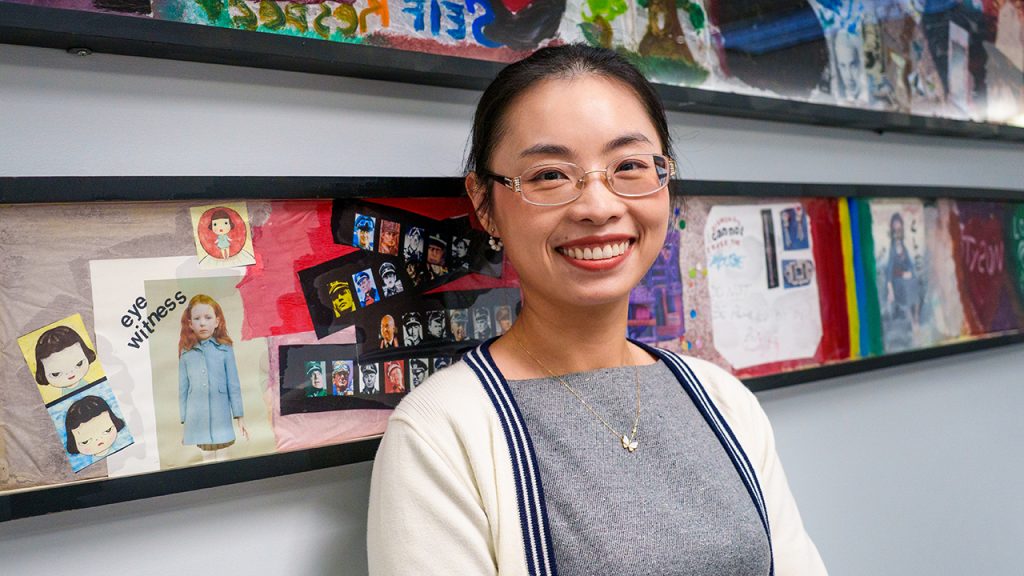
A Fordham social work professor will receive a prestigious national award for her research illuminating how children are affected by violence between the adults raising them.
Yafan Chen, PhD, will be presented with the Violence Against Women and Children Manuscript Award next week at a conference of the Council on Social Work Education (CSWE) in Atlanta, Georgia.
“It really means a lot to me,” Chen said, “because it feels like a huge acknowledgment from the entire social work discipline and profession.”
A New Approach to a Well-Studied Problem
The study that Chen led, published this year in Child Abuse & Neglect, tackles an all-too-common problem through a different lens. While plenty of studies show that exposure to intimate partner violence hurts children’s well-being throughout their lives, few have taken her study’s more detailed look at when that exposure happens, and whether it’s a chronic problem or an occasional one.
Children can have “very distinct experiences” of intimate partner violence when they’re exposed at different phases for different durations, she said.
Examining these factors, the study gives a more nuanced picture of the anxious and depressive symptoms children can suffer as a result, providing insight that could inform mental health treatments. And for anti-violence researchers like her, she said, the ultimate goal is to bring about an end to the violence itself.
“I just truly believe everyone deserves to have a very happy and healthy childhood, because that really serves as the basic foundation of their lifetime well-being and also success,” Chen said. “I really hope that my work can really … [send]messages to the entire world about what this group is experiencing, what we can do to really help and support them.”
Findings
Her study relied on data from a study of 1,495 children conducted over more than two decades, beginning in 1998. It focused on mothers whose partners subjected them to physical, psychological, or sexual violence, as well as controlling behaviors, and the impact on their children.
She reviewed depression and anxiety symptoms in 15-year-olds in that study who were exposed to intimate partner violence earlier in life.
Her research identified three patterns of exposure and examined their unique effects. Children in one group had low exposure throughout childhood; out of the three groups, they had the mildest symptoms of anxiety and depression at age 15.
Children in a second group were frequently exposed early in life, starting in their infancy and peaking when they were toddlers. They had worse symptoms of both depression and anxiety compared with children in the first group, perhaps because exposure to violence kept them from forming secure attachments to their caregivers and learning emotional regulation skills. “Clinicians may need to work on rebuilding these very foundational skills,” Chen said.
A third group had low exposure to intimate partner violence as infants and toddlers but greater exposure during their first few years of school. They had worse symptoms of depression, but not anxiety, compared to the first group. Because they had more stable early childhood years, they may have built a foundation for greater resilience during their school years, Chen said.
The study’s detailed findings “provide implications to
practice, which can actually make a real-world impact to really change and support the children and the families,” Chen said.Chen’s co-authors on the study are Lauren Manley-Sayin of Rutgers University and Susan Yoon of The Ohio State University and Ewha Womans University in South Korea.
More than a dozen other faculty members and administrators from the Graduate School of Social Service will attend next week’s CSWE conference, including associate dean and longtime GSS faculty member Elaine Congress, DSW, who will be presented with the Significant Lifetime Achievement in Social Work Education Award. GSS faculty will present on everything from AI in social work education and justice for those with disabilities to the special education process and mental health among Latina youth.
